

By Zola Mkhize | Editor-in-Chief, Everything ZA TravelHidden Gems / Off the Beaten Track | 16 July 2026
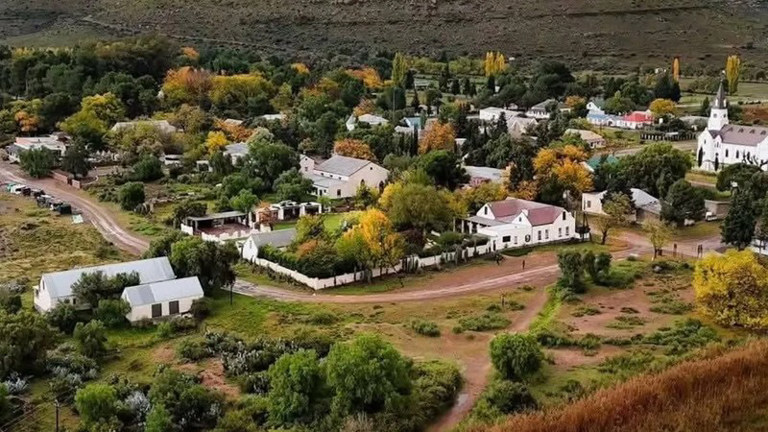
There is a place in the Eastern Cape where the dust settles differently. Where the silence is not empty but full – full of wind moving through ancient pear trees, full of water murmuring through stone furrows built more than a century ago, full of stars so thick and close you could reach up and cup a handful. That place is Nieu-Bethesda. And if you have never heard of it, that is almost entirely the point.
Tucked into a fold of the Sneeuberg Mountains, about 50 kilometres north of Graaff-Reinet, this small Karoo village of roughly 600 souls has resisted every invitation to become something it is not. There are no streetlights. No ATM. No petrol station. No fast food. The streets are unpaved and the electricity arrives on Eskom’s schedule, not yours. And yet, for the travellers who find their way here – and who come back, because they always come back – Nieu-Bethesda is one of the most alive places in South Africa.
This is a village that asks something of you. It asks you to slow down. To arrive without an itinerary. To eat what is available and sleep when the dark comes. In exchange, it gives you something rare: a genuine encounter with South Africa as it once was, and as some of us still want it to be.
A Woman, A House, and a Vision That Changed Everything
You cannot talk about Nieu-Bethesda without talking about Helen Martins. You could argue she is the reason the village still exists the way it does – frozen, particular, and fiercely itself.
Helen Martins was born here in 1897. She was quiet and reclusive, a schoolteacher’s daughter who studied, married, divorced, and eventually returned to the house where she was born. What happened next is one of the most astonishing acts of individual creative will in South African history.
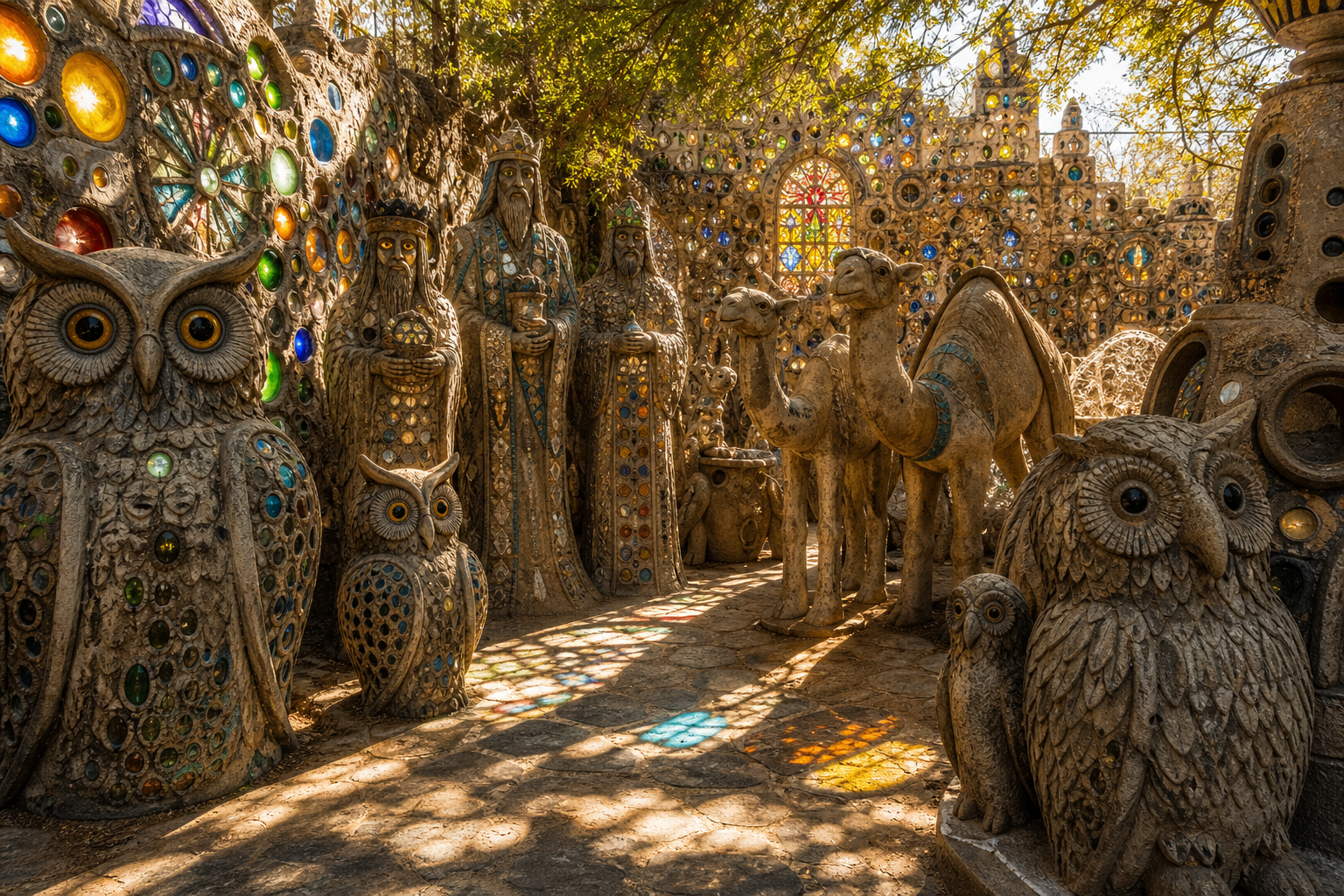
Beginning in 1945, at the age of 48, she began transforming her modest Karoo home. She ground coloured glass into fine powder and pressed it into the walls so they would catch and throw light in every direction. She mixed concrete and shaped it by hand into hundreds of figures – owls with wide, solemn eyes, camels mid-step, wise men, mermaids, pyramids, angels. She drew on Islamic, Christian, and pagan symbolism without hierarchy, weaving them into a single, sprawling vision. By the time she died in 1976, she had created over 300 sculptures, an entire Camel Yard, and a house that shimmers and glows in ways that should not be possible from concrete and broken glass.
The world took notice slowly, then all at once. Playwright Athol Fugard wrote The Road to Mecca in 1984 – the play that introduced Helen’s story to international audiences, the title drawn from the direction in which most of her figures face. The Owl House is now a National Heritage Site and recognised internationally as a major example of outsider art: raw, deeply personal, unmediated by the art world or its fashions.
Entry costs around R80 to R100. Most visitors spend one to two hours inside, though the honest experience demands more. This is not a place for a quick photograph and a glance. The Owl House rewards stillness. Sit in the Camel Yard and watch how the light moves across the figures as the morning turns to afternoon. That is when you begin to understand what Helen was building – not just sculptures, but a whole interior world made visible.
The Village Itself Is the Experience
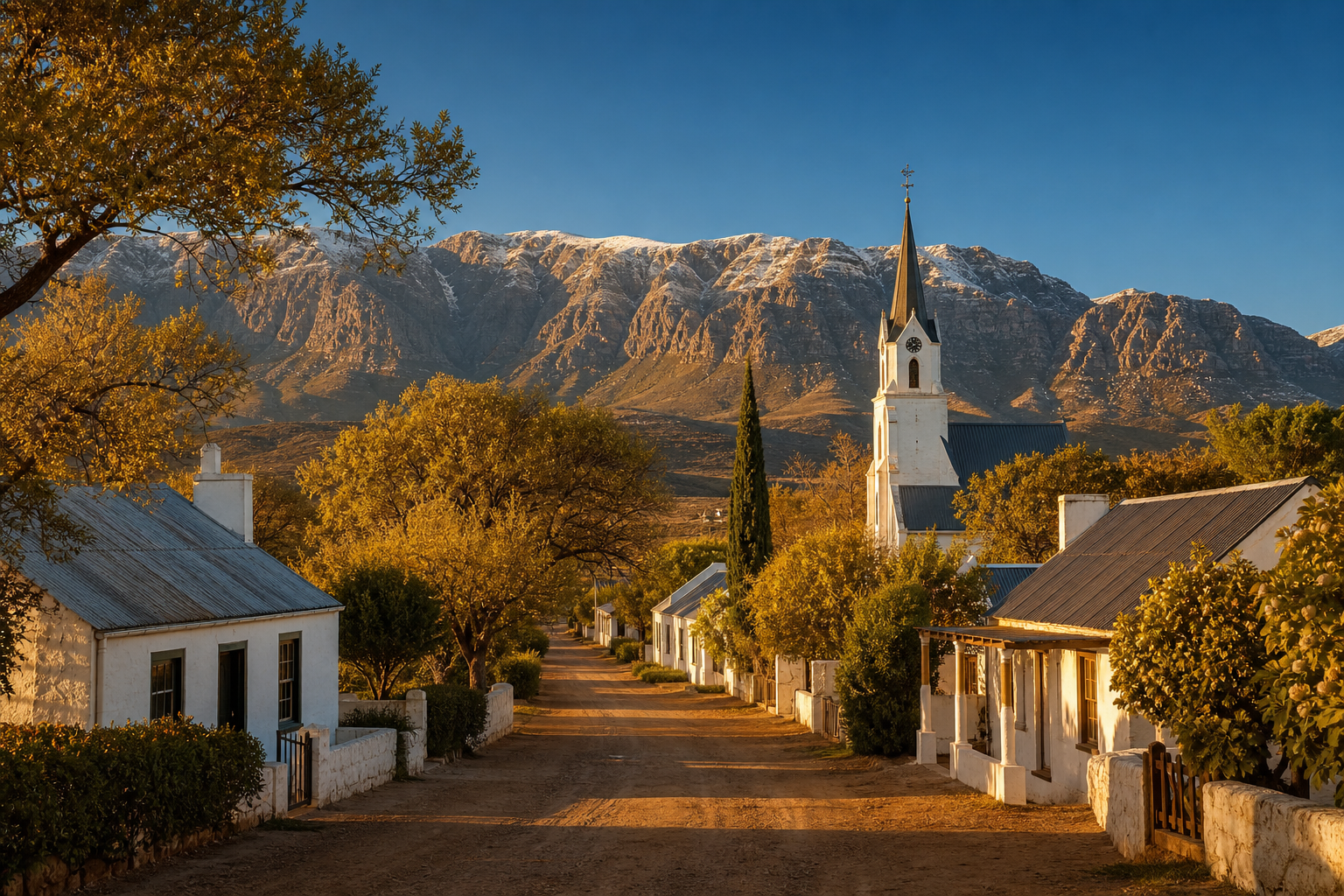
Beyond the Owl House, Nieu-Bethesda is a village you experience by walking through it – slowly, without purpose, letting it come to you.
The water furrows are one of the first things you notice. This ancient irrigation system, built when the village was founded in 1875, still carries water down from an eternal spring on the plateau above, threading through the streets in channels that babble quietly beside the road. It is one of the last functioning furrow systems in South Africa. Walking beside them at dusk, when the light turns amber and the water catches the colour, is one of those simple pleasures you carry back to the city and think about for weeks.
The Dutch Reformed Church, built in 1905, anchors the village visually. Its white walls and clock tower steeple are the first thing you see arriving from Graaff-Reinet. Inside, the original gas chandeliers – installed before electricity reached the village – still hang in place. Sunday services continue, attended by a small and faithful congregation. The interior is one of those genuinely serene spaces that require nothing from you except to be in it.
Wander further and you find small galleries tucked into whitewashed rooms, artists who moved here seeking something quieter and stayed. You find The Brewery, the village pub, where locals and travellers share cold beer and whatever news has drifted in. You find Die Galery restaurant for Karoo cuisine – slow-roasted lamb, boerewors, rusks and rooibos – cooked the way it has always been cooked.
Getting High: Compassberg and the Trails Above the Village
For the walkers and the climbers, the Sneeuberg range above Nieu-Bethesda offers one of the Eastern Cape’s most rewarding day hikes. Compassberg, at 2 502 metres, is the highest peak in the province – and on a clear day, which is almost every day, the views extend across an ocean of flat Karoo stretching to every horizon.
The full summit hike is a serious full-day undertaking, six to eight hours return, requiring reasonable fitness and a guide for first-timers. Local guides are available through the village tourism office. The shorter Kombuisnek Trail, threading through a Sneeuberg ravine in three to four hours, offers a taste of the mountain landscape at a more manageable pace. Both are best in spring or autumn, though winter sunrise hikes have a particular magic – the frost on the ground, the silence, the slow spread of light across the Karoo below.
Night hiking, or simply sitting outside at night, brings another dimension entirely. Nieu-Bethesda has zero light pollution. The Milky Way is not a faint smudge here – it is a river of light overhead, extravagant and overwhelming. Several guesthouses offer telescope sessions. But honestly, you don’t need a telescope. Just lie on your back in the dark and look up.
Budget Breakdown: Nieu-Bethesda Won’t Break You
One of the quiet joys of this village is that it was never designed for the wealthy. Budget travellers have been finding their way here for decades, and the infrastructure reflects it.
Accommodation:
- Backpacker dormitory beds from R200–R250 per night
- Self-catering cottages from R400–R600 for the whole unit (ideal for couples or small groups)
- Guesthouses with breakfast from R600–R900 per night
Food:
- Self-cater from groceries bought in Graaff-Reinet: R60–R120 per person, per day
- Pub meal at The Brewery: R80–R150
- Restaurant dinner at Die Galery: R150–R250
Activities:
- Owl House entry: R80–R100
- Hiking (self-guided): free
- Guided Compassberg hike: ask locally for current rates
A budget traveller can spend a full day in Nieu-Bethesda for R500–R700, including accommodation, meals, and the Owl House. Bring cash from Graaff-Reinet – there is no ATM in the village. Fill your petrol tank before you leave town. And bring groceries; Die Winkel, the village shop, stocks the basics but not much beyond them.
Getting There
From Gqeberha/Port Elizabeth: About 3.5 hours via the N10 to Graaff-Reinet, then north to Nieu-Bethesda. The road into the village is tarred all the way – manageable in any regular car. After rain, the alternative gravel route becomes slippery; stick to the tar.
From Cape Town: Around 8 hours via the N1 through Beaufort West to Graaff-Reinet.
From Johannesburg: About 8 hours via the N1 south through Bloemfontein.
There is no public transport directly to Nieu-Bethesda. The nearest bus stops are in Graaff-Reinet; from there you can arrange a local taxi or car hire.
Download offline maps before you leave. Cell signal is unreliable. This is not a warning – it is an instruction.
When To Go
Winter (June–August) is, in my opinion, the secret best season. Yes, the nights drop below zero. Yes, you need a fireplace and proper warm layers. But the skies are at their clearest, the Milky Way at its most dramatic, the village at its quietest. There is a particular quality to a Karoo winter morning – the frost on the ground, the woodsmoke from cottage chimneys, the silence so complete you can hear your own heartbeat. Come for that.
Spring (September–November) brings wildflowers, warmer days, and slightly more company. Autumn (March–May) is similarly beautiful and calm.
Avoid school holidays in June and December if you want solitude. The village fills up faster than people expect.
A Final Word
There is a reason writers and artists keep ending up in Nieu-Bethesda. Something about the Karoo does to the mind what the village itself does to the body – strips away the noise and leaves what is essential. Helen Martins spent 31 years here building a world out of concrete and broken glass. Athol Fugard wrote some of his finest work here. Ordinary South Africans have been making pilgrimages to this dusty, unhurried corner of the Eastern Cape for generations.
You don’t need to be an artist or a writer to feel it. You just need to arrive slowly, bring enough time, and resist the urge to do anything at all for at least one full afternoon.
That, it turns out, is the whole point.


