Image Source: Inverdoorn
By Zola Mkhize | Editor-in-Chief | Hidden Gems / Off the Beaten Track
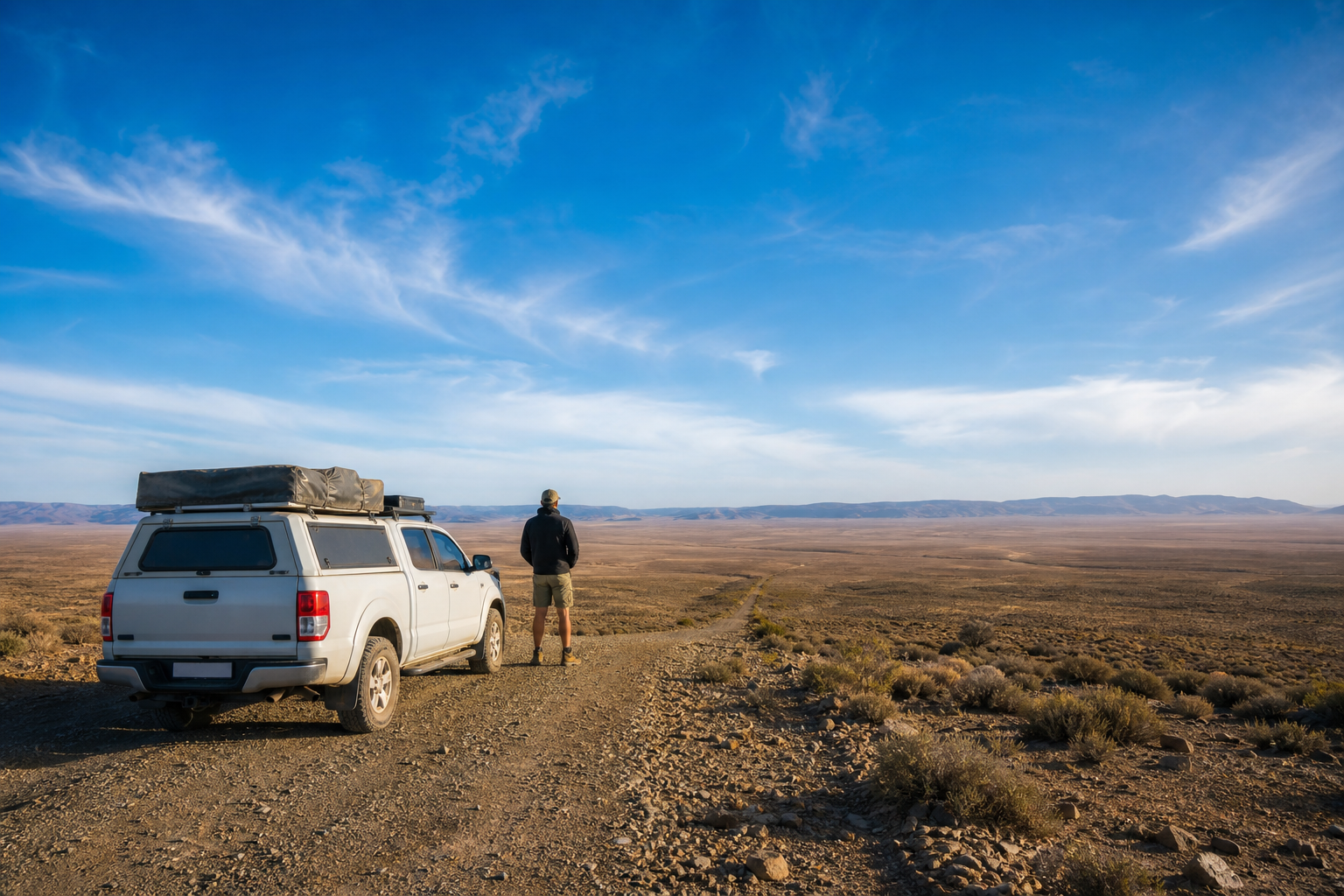
There is a place in the Northern Cape where the land runs so far in every direction, and so utterly flat, that the sky becomes the main event. Not as background. Not as context. As the entire world. You step out of your car on a Tankwa gravel road and the silence hits you first – not the mild quiet of a suburban garden at midnight, but an actual, physical absence of sound so complete you can hear your own blood. Then the sky unfolds above and around and beneath the horizon, and you understand that you have come somewhere genuinely enormous.
The Tankwa Karoo is not on most South African travel shortlists. It should be.
Where Is It?
The Tankwa Karoo National Park occupies a vast stretch of the Roggeveld-Karoo basin in the Northern Cape, roughly three hours from Cape Town via the N1 and R355, or five hours from Johannesburg via the N1 and Touws River. The R355 – an unsurfaced, untarred gravel road that bisects the park from south to north – is one of the most spectacular drives in the country and, outside the brief windows of AfrikaBurn (which takes place in the park each April), is almost entirely devoid of other vehicles.
The park covers approximately 143,000 hectares. On busy days, you might encounter a dozen other visitors. On most days, fewer.
The Landscape: Earned Beauty
Let me be honest with you about the Tankwa Karoo: it does not give itself up immediately. The landscape does not advertise. There are no dramatic peaks, no waterfalls, no postcard-obvious focal points. What there is, instead, is an accumulation – of light, of texture, of silence, of scale – that builds slowly and then, somewhere in the second or third hour, becomes overwhelming.
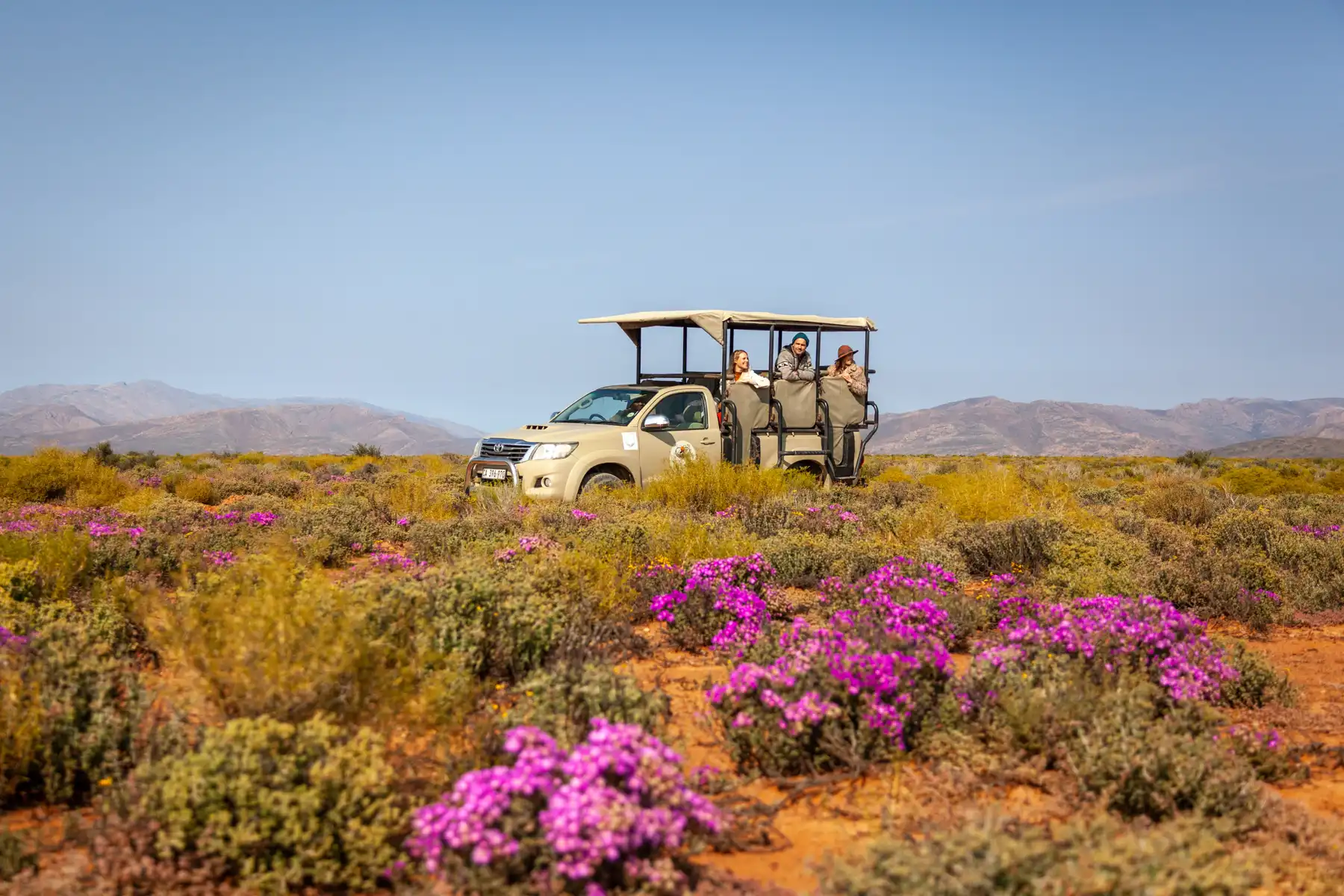
The plains are covered in a mosaic of dwarf succulent shrubs: the strange, sculptural forms of ganna, bossieveld and spekboom that turn the ground into a living carpet of grey-green and silver. In spring (August–September), when the winter rains have worked their magic, the Tankwa erupts in wildflowers – orange, yellow, white and magenta Namaqualand daisies stretching across the flats in a spectacle so improbable it has been known to stop drivers dead in the road.
In July, the show is different: spare, sculptural, endlessly photogenic in a way that rewards patience. The light at dawn and dusk does something extraordinary to the Roggeveld mountains on the eastern horizon – burning them red and violet in sequence, the colours changing minute by minute until the sky goes dark and the stars take over.
And the stars. I need to talk about the stars.
The Tankwa Night Sky
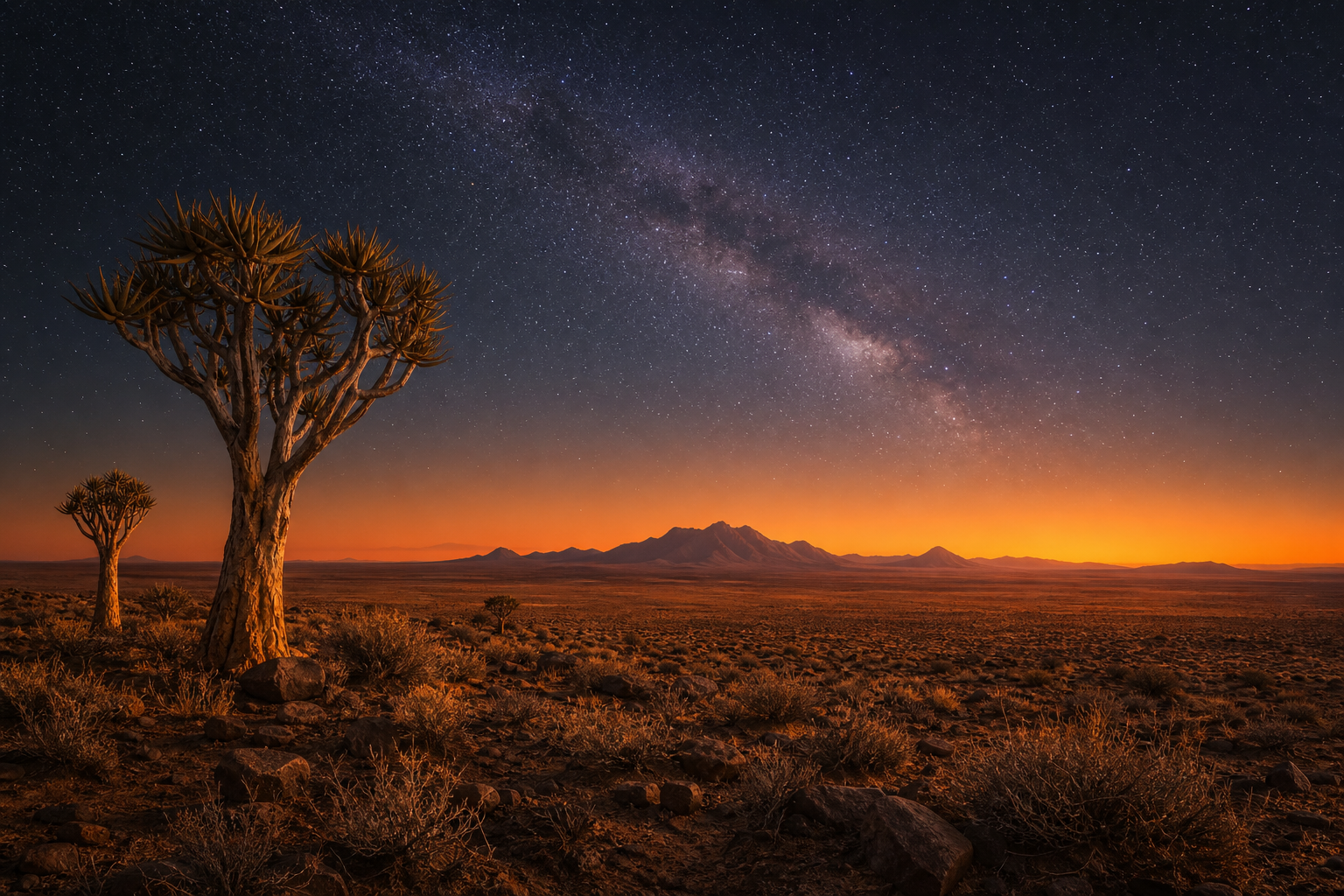
The Tankwa Karoo sits in one of the lowest light-pollution zones in southern Africa. On a clear winter night – and July nights are almost universally clear – the Milky Way does not look like a smudge or a suggestion. It looks like a road. A dense, luminous river of light arching from one horizon to the other, with the dark lanes of the galactic dust clouds visible as negative space against the glow.
The Southern Cross hangs at a useful angle. Scorpius sprawls magnificently across the eastern sky. And if you lie on your back on the gravel for long enough – which I strongly recommend – the depth of the sky becomes apparent: not a ceiling painted with lights, but an actual volume, a three-dimensional space you are at the bottom of, looking up through.
South Africa has some of the best night skies in the world. The Tankwa Karoo has some of the best in South Africa. Bring a flask of something warm and two hours of nothing else to do.
Getting There and Around
The Tankwa is best accessed in a vehicle with decent ground clearance – not necessarily a proper 4×4, but ideally a high-clearance 4×2 at minimum. The R355 is gravel and can develop significant corrugations after rain. In dry winter conditions it is generally manageable in a standard sedan if you drive slowly, but a bakkie or SUV will serve you much better.
From Cape Town (± 3 hours):Take the N1 toward Touws River, then the R354 through Matjiesfontein to Sutherland, turning north onto the R355 through Middelpos into the park. Alternatively, approach from the south via Ceres and the Gydo Pass on the R46 – a scenic option that adds about 45 minutes.
From Johannesburg (± 5 hours):Take the N1 south to Touws River, then follow the same southern approach through Matjiesfontein. The Karoo Poort – the mountain pass between Worcester and the Hex River Valley on the N1 – is worth slowing down for.
Fuel: Fill up in Ceres, Touws River, or Calvinia. There are no fuel stops inside the park.
Where to Stay
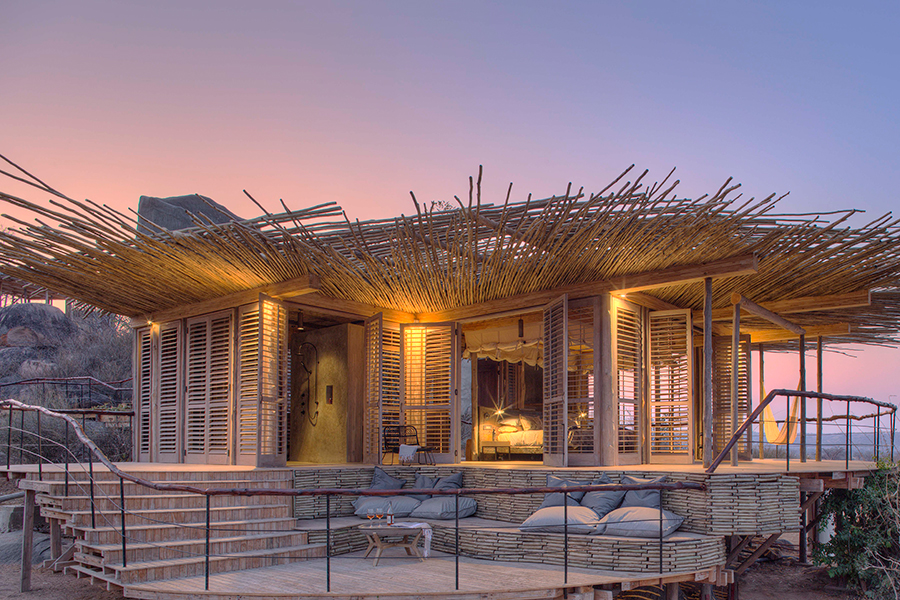
Camping in the park: SANParks maintains basic campsites at Elandsvlei and Perdekloof – pit toilets, cold water, no electricity, affordable (check SANParks website for current rates, typically under R250/person/night). This is the right way to experience the Tankwa night sky. Bring your own firewood and food; there is nothing to buy inside the park.
Tankwa Padstal: The legendary Tankwa Padstal (roadside stall) at the midpoint of the R355 is one of South Africa’s great rural institutions – a tiny farm stall serving boerewors rolls, coffee, and cold drinks to passing travellers in the middle of absolute nowhere. It has been operating since before most of its customers were born, and long may it continue. Stop here. Have the boerewors roll. Sign the visitor book.
Calvinia: The small town of Calvinia, on the park’s northern boundary, offers proper guesthouses and the excellent Hantam Huis heritage guesthouse for those who want a roof and a hot shower. Calvinia’s museum is a quiet treasure – a record of the semi-arid Hantam district’s farming and missionary history housed in a 19th-century Dutch Reformed building.
Wildlife: Patient Rewards
The Tankwa Karoo is not a Big Five reserve. Adjust expectations and be rewarded accordingly.
The park holds healthy populations of springbok, gemsbok, Hartmann’s mountain zebra, and – more rarely seen – aardwolf, bat-eared fox, and Cape fox. Birdlife is exceptional for desert specialists: Ludwig’s bustard, Karoo korhaan, Namaqua sandgrouse, and the strikingly beautiful Karoo chat are regulars. Raptels circling the midday thermals include lappet-faced vulture, martial eagle, and black-shouldered kite.
The key to wildlife in the Tankwa is the same as the key to the landscape: patience and early starts. Drive slowly on the park roads before 8am and after 4pm. Pull over and wait. The Karoo teaches a particular pace, and it is worth learning.
Why You Should Go in July Specifically
July offers the Tankwa at its most austere and most beautiful. The wildflower season is a month or two away but the rains have freshened the ground. The days are clear and crystalline, temperatures hovering between 6°C at night and 18°C by midday – cold enough to need a fleece, warm enough to stand outside comfortably at noon. The park is nearly empty of other visitors.
AfrikaBurn in April brings thousands of people to this same landscape; they leave behind little except tyre tracks and the legend. In July, the Tankwa has returned entirely to itself. You arrive as a guest, not a participant. That is the better deal.
The Practical List
- Entry: SANParks daily conservation fee (approximately R240 for adults; SANParks Wild Card accepted)
- Camping: From ± R250/person/night (basic facilities only)
- Nearest town with fuel and supplies: Ceres (south) or Calvinia (north)
- Road conditions: Gravel R355; high-clearance vehicle recommended
- Cell signal: Effectively none inside the park. Tell someone your itinerary before you leave.
- Best time to visit: April–May (wildflowers, spring); July–August (winter clarity, empty roads)
- SANParks booking: www.sanparks.org
The Tankwa does not ask anything of you. It simply exists, on a scale that makes your own dimensions feel briefly and usefully approximate. Go once. Go again. The emptiness is the point.