By Zola Mkhize | Editor-in-Chief | Hidden Gems / Off the Beaten Track
There is a moment that happens at De Hoop, somewhere between arriving and your first morning walk, when you realise you have made it to one of those places. The kind of place people whisper about. The kind they don’t post about too loudly, because they want it to stay exactly the way it is.
De Hoop Nature Reserve sits on the Western Cape coast, roughly four hours from Cape Town, tucked into the Overberg region behind a road that doesn’t announce itself. It is not on the Garden Route. It is not near any major town. It does not have a franchise coffee shop, a strip mall, or a tourist bus in sight. What it has – and what it has had since long before we arrived to notice – is a 36,000-hectare wildness that includes the largest surviving coastal fynbos ecosystem in the world, a marine protected area stretching 5km out to sea, and from May to November, some of the best land-based whale watching on the entire African continent.
Right now, in the depths of the South African winter, De Hoop is arguably at its most spectacular. The southern right whales are here.
The Whales Came Back
Every year, when the cold Benguela Current pushes north along the Cape coast, the southern right whales follow. These are enormous, barnacle-crusted, unexpectedly gentle creatures that come to the sheltered bays of the Southern Cape to calve, nurse, and simply be. They have been doing this for millions of years. Humans nearly stopped it in the 19th century – southern rights were hunted almost to extinction by commercial whalers who prized them for their high oil yield and their obliging tendency to float when killed (hence the name: they were the “right” whale to hunt).
Recovery has been slow, measured in decades, and De Hoop has been central to it. The marine protected zone was one of the first in South Africa to strictly regulate boat traffic and human interaction near whales, and the results are visible. From the white dunes above the beach – dunes so tall and so white they feel like something from another continent – you can watch whales breaching, slapping their massive tails, spy-hopping to look at you while you look at them. No boat required. No R800 charter fee. Just you, a pair of binoculars if you have them, and the sound of the sea.
Mother-calf pairs are common in July and August. If you are lucky – and at De Hoop, luck seems to favour the prepared – you may watch a cow teaching her calf to breach. There is nothing quite like it. Not in a David Attenborough way, but in the way that makes you go quiet in a room full of people you love.
Where to Stay: De Hoop Collection
The accommodation at De Hoop is run by De Hoop Collection, a family-owned operation that has managed the property for decades with a philosophy of low-impact, high-character hospitality. They offer a range of options that genuinely accommodate different pockets – which in South Africa, means something.
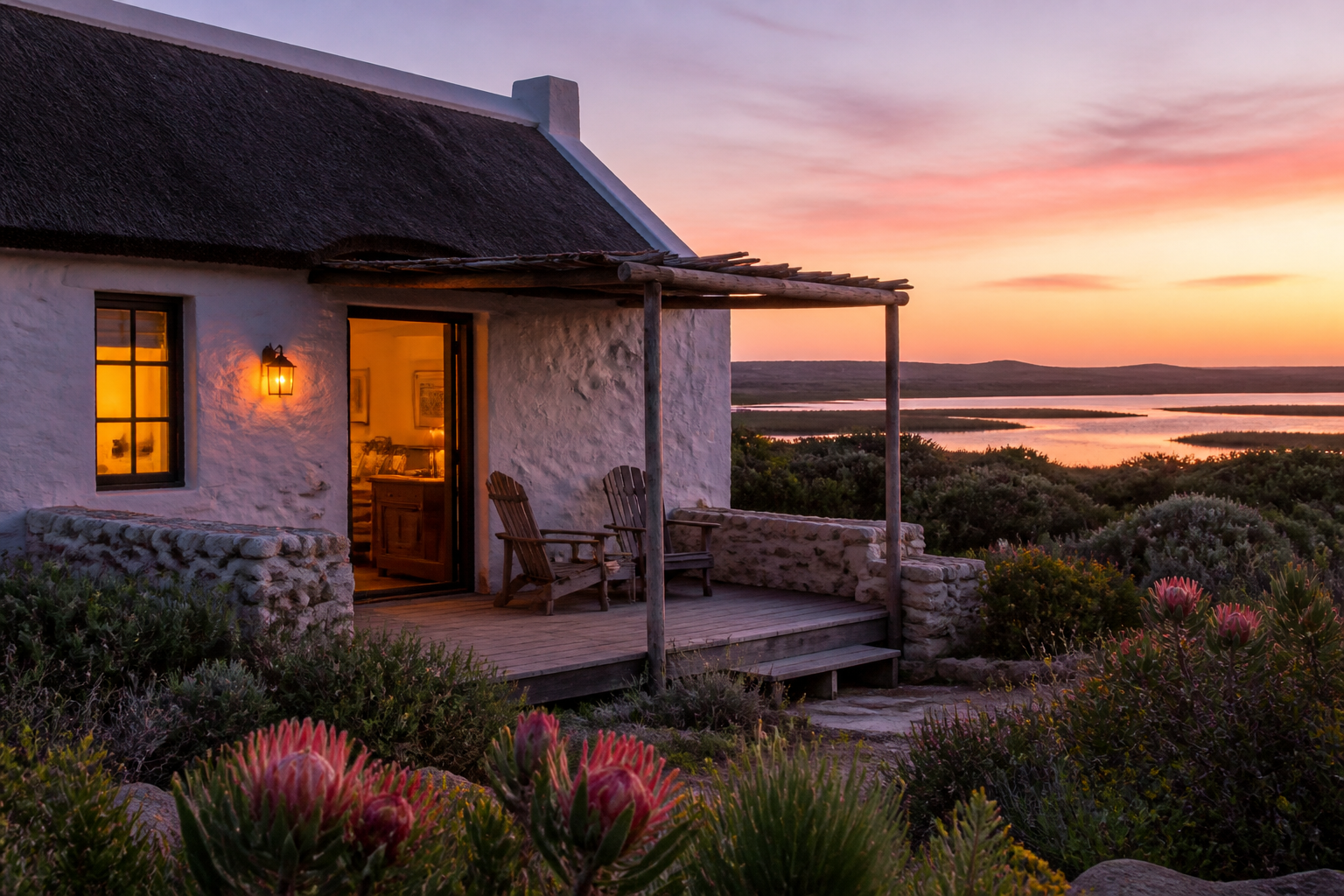
The Cottages (Self-Catering) are the sweet spot for budget-conscious travellers who want character over compromise. These are whitewashed, thatched-roof cottages scattered through the fynbos near the vlei (the brackish lake that runs parallel to the beach). They are solidly equipped – full kitchen, braai facilities, bedding, towels – and they come with the particular luxury that money cannot fully buy: the sense that you are sleeping in the landscape, not adjacent to it. Prices for the self-catering cottages run from approximately R5,950 per unit per night (April–September), sleeping up to six people. Divided among three couples or a family of six, that is under R1,000 per person. Minimum two-night stay applies.
The Fig Tree Camp is the entry-level option – basic self-catering units that feel like a proper bush camp, down near the vlei, with the kind of simplicity that becomes a feature rather than a compromise. If you have been camping your whole life and you just want a roof and a braai, this is your home.
The Opstal (Fully Catered Lodge) is the splurge option: a restored Cape Dutch homestead that sleeps sixteen, with a chef, a plunge pool, guided activities, and the sort of whitewashed-wall elegance that photographs well and feels even better in person. Rates from R3,400 per person per night full-board. For a special occasion – a milestone birthday, a proposal, a family gathering that needs a centrepiece – it is hard to argue with.
What to know before you book: De Hoop is remote. The nearest town, Bredasdorp, is 50km away on gravel road for the last stretch. Bring your groceries, your wine, your firewood, and your patience with mobile signal. The trade is worth it.
Beyond the Whales
The whales are the headline, but De Hoop is a full-length story.
The Vlei. The 15km-long De Hoop Vlei is a Ramsar-listed wetland – that means it is internationally recognised as a wetland of global significance. It is a birder’s obsession: African fish eagles, flamingos, pelicans, and more than 260 other species use the vlei at various times of year. Guided boat cruises run from the reserve – book in advance, they fill early in whale season. Even without a guide, walking the vlei edge at dawn, when the mist is still sitting on the water and the first light is making everything amber, costs nothing beyond the R230 per person conservation fee at the gate.
The Fynbos. This is the part non-botanists usually underestimate until they are actually in it. The Cape Floristic Region contains approximately 9,000 plant species, roughly 70% of which are endemic – meaning they grow nowhere else on earth. In July, the proteas and ericas are doing what they do: flowering in complete indifference to the cold, in colours that have no business existing in a winter landscape. Walk any of the hiking trails (the Potberg Trail, 5 days and 55km for the committed; shorter day walks for everyone else) and you will emerge with a new relationship to the word “biodiversity.”
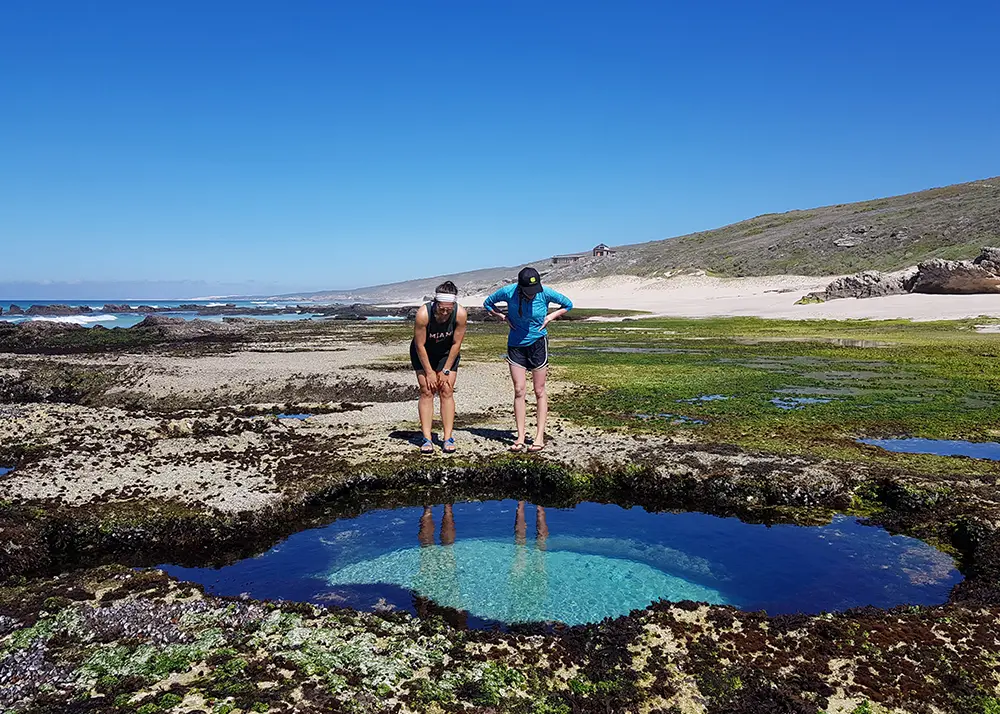
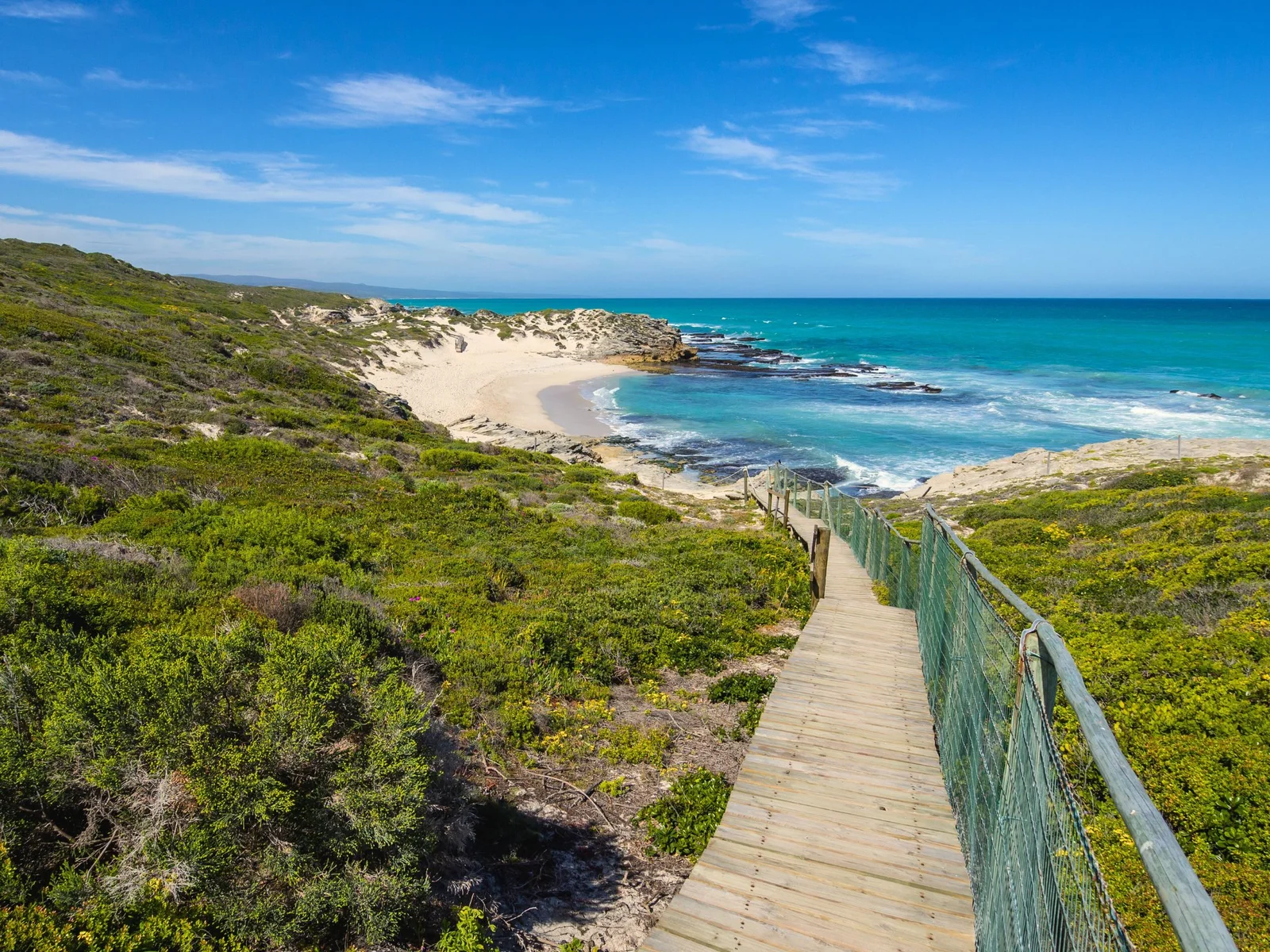
The Beach. The De Hoop beach is a 14km stretch of white sand backed by dunes. No development. No vendors. No flags marking off swim zones. In winter it is usually deserted except for the oystercatchers and the odd otter. You walk it at whatever pace you choose, and when you have had enough, you turn around. That is the entire activity, and it is enough.
Wildlife. The reserve is home to Cape mountain zebra, bontebok (one of the world’s most endangered antelope, brought back from the brink by exactly the kind of conservation work this reserve represents), eland, baboon, leopard (present but rarely seen – which is the correct relationship to have with a leopard), and more than 260 bird species. No Big Five. No traffic jams at sightings. Just animals living in their place while you pass through it.
The Practical Truth
Gate fee: R230 per person per day (SANParks rates; De Hoop Collection may vary slightly for accommodation guests – included for some packages).
Best time to visit: May to November for whales. August–September adds the full spring flower spectacle in the surrounding Overberg. Avoid major school holidays if you want true solitude – De Hoop is popular with Capetonians who know better than to tell too many people about it.
Getting there: Head east from Cape Town on the N2, then south past Caledon toward Bredasdorp. From Bredasdorp, follow the R319 and then the gravel road to Wydgeleë gate. Total from Cape Town: roughly 3.5 to 4 hours depending on road conditions. A standard sedan handles the gravel fine in dry weather. Call ahead after heavy rain.
Cell signal: None to speak of once you are inside the reserve. Download your maps, pack your podcasts, and let the absence of signal become the point.
Booking: Via De Hoop Collection at www.dehoopcollection.com. Book at least four to six weeks ahead for winter whale season – it is not as unknown as it used to be.
Why Now
There is a particular kind of guilt that comes with being South African and not yet having been to De Hoop. We live four hours from one of the most extraordinary coastal wildernesses on the continent, and most of us have spent more time in Bali than in the Overberg.
July is whale season. The fynbos is extraordinary. The cottages have fireplaces. The beach is empty.
There is really no reason to wait for the right time, because this is it – the Southern Cape winter, unhurried and cold and full of the particular magic that only comes when the crowds have gone and the whales have arrived and the world narrows down to what matters.
Pack warm. Bring firewood. Go to De Hoop.
Zola Mkhize is Editor-in-Chief of Everything ZA Travel. De Hoop has been on her list for two winters too long. She is correcting that in August.
Accommodation details: De Hoop Collection | Conservation fee at gate. Booking recommended.