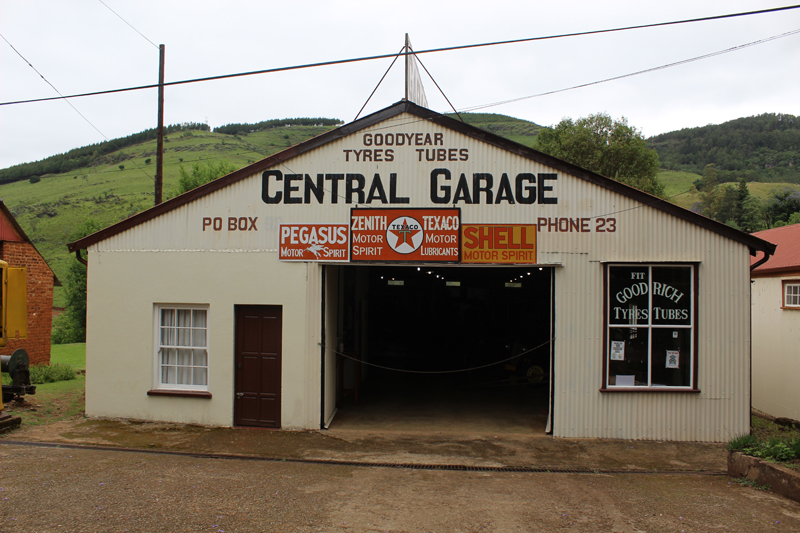
Wander the dusty streets of Pilgrim’s Rest and step straight into 1880s South Africa. Budget-friendly, deeply atmospheric, and genuinely off the beaten track
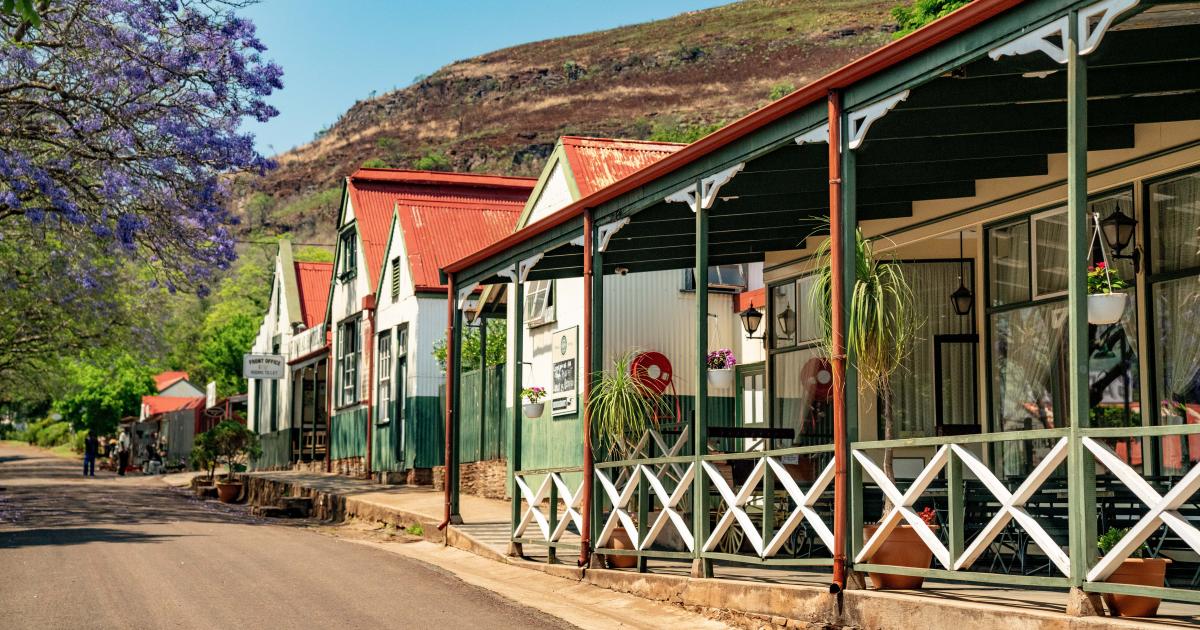
Pilgrim’s Rest is a genuinely frozen-in-time gold-rush town where you can walk streets that look exactly as they did in 1880, stay overnight in heritage accommodation from R200–400 per night, and spend an entire day exploring museums, heritage buildings, and mountain trails for under R100 in entry fees. It’s refreshingly unpretentious, deeply atmospheric, and beloved by South Africans who know it – but still quiet enough to feel like you’ve stumbled onto something forgotten.
The moment you turn down the main street of Pilgrim’s Rest, red dust settling around your shoes, you feel it: the weight of time. The buildings aren’t reconstructed or polished for tourism. They’re original – stone walls that have stood since the 1880s, verandahs where miners once gathered, shop windows frozen mid-display. The air smells like history: old wood, mountain earth, the particular silence of a place that stopped rushing decades ago and never quite caught up.
This is what happened when gold was found here on 22 September 1873. The news travelled fast enough that by 1874, a tent city of prospectors, fortune-seekers, and traders had sprung up in these Mpumalanga mountains. They dug, they struck it rich, they built permanent structures, and for the better part of fifty years, Pilgrim’s Rest was one of South Africa’s most important boom towns. But like all booms, this one cooled. The easier alluvial gold ran out, industrial mining took over elsewhere, and the prospectors moved on. What remained was a small village of 1,700 people, a place where time seemed to pause in 1920, and the buildings decided to wait.
That’s the magic of this hidden gem – and why you should visit before everyone finds out.
A Town Built on Dreams and Dust
Pilgrim’s Rest isn’t a theme park or a reconstructed museum village. It’s a genuinely living town where real families still live in those heritage buildings, where the post office still operates from the same counter, where descendants of miners’ families run the small hotels and restaurants. The difference is profound – it means the place breathes authenticity rather than performance.
The gold story starts with what the locals call the “Robber’s Grave” legend: a prospector named Tom McLachlan who supposedly struck gold in 1873 and hid his fortune in these mountains before his sudden death, leaving a secret he took to his grave. Whether true or not, the story electrified the region. Within months, the tent camps grew into wooden buildings. Within a decade, they were replaced by stone structures – some still standing today. The first major gold rush in South Africa was born, and Pilgrim’s Rest became a town of opportunity, danger, and wild ambition.
By the peak years – roughly 1873 through the 1920s – Pilgrim’s Rest was a proper town: it had newspapers, a multi-storey hotel, banks, shops, a school, and a thriving population of miners, traders, and families betting their futures on yellow metal. The place had the energy of a frontier town where fortunes could change overnight. Today, those buildings still stand in their original locations, most of them preserved, some of them still in everyday use. Walk past the House Museum (where you can step inside a miner’s home exactly as it was), the Print Works (still contains the original printing press), and the village shops, and you’re not seeing a recreation – you’re seeing the actual spaces where these lives unfolded.
Why Pilgrim’s Rest Feels Like Nowhere Else
The sensory experience is what stops visitors. The light here is particular – when the afternoon sun angles through the street, it turns the red earth and stone buildings into shades of amber and rust. The surrounding mountains (part of the Panorama Route region) are permanently misty during winter, which makes the whole village feel like it’s suspended in a sepia photograph. There’s almost no noise – a few voices, the occasional footstep on gravel, wind through the trees. What you notice most is what’s not there: no traffic, no crowds, no commercial hustling. Just people moving slowly through a town that seems to have made peace with being left behind.
Local guides describe it as “a place where you can hear yourself think.” For South Africans used to the chaos of Johannesburg, Cape Town, or Durban, it’s a relief. For travellers seeking Instagram backdrops, it’s either disappointing (the aesthetic is too subtle, the light too soft, the pace too slow) or genuinely revelatory (which is why the people who fall in love with this place tend to fall hard).
The climate reinforces the atmosphere. From May through September, the Mpumalanga high veld sits in a crisp winter. Mornings are cold – you’ll want a sweater – and mists roll through the valleys. The light is clearer, the hiking is comfortable, and the whole town takes on this cool, contemplative mood. Summers are warmer but humid and prone to afternoon rain, which isn’t terrible but does dampen the experience.
What to See and Do (Without Spending Much)
The entry fee is R30 per person – genuinely one of South Africa’s best-value heritage experiences. That gets you access to wander the entire village, pop into the main museums (House Museum, Print Works, Church Museum), and explore the heritage buildings at your own pace. Guided heritage tours run about R100–150 per person and are worth it if you want the stories and context that bring the buildings alive; most guides are local and have family ties to the place.
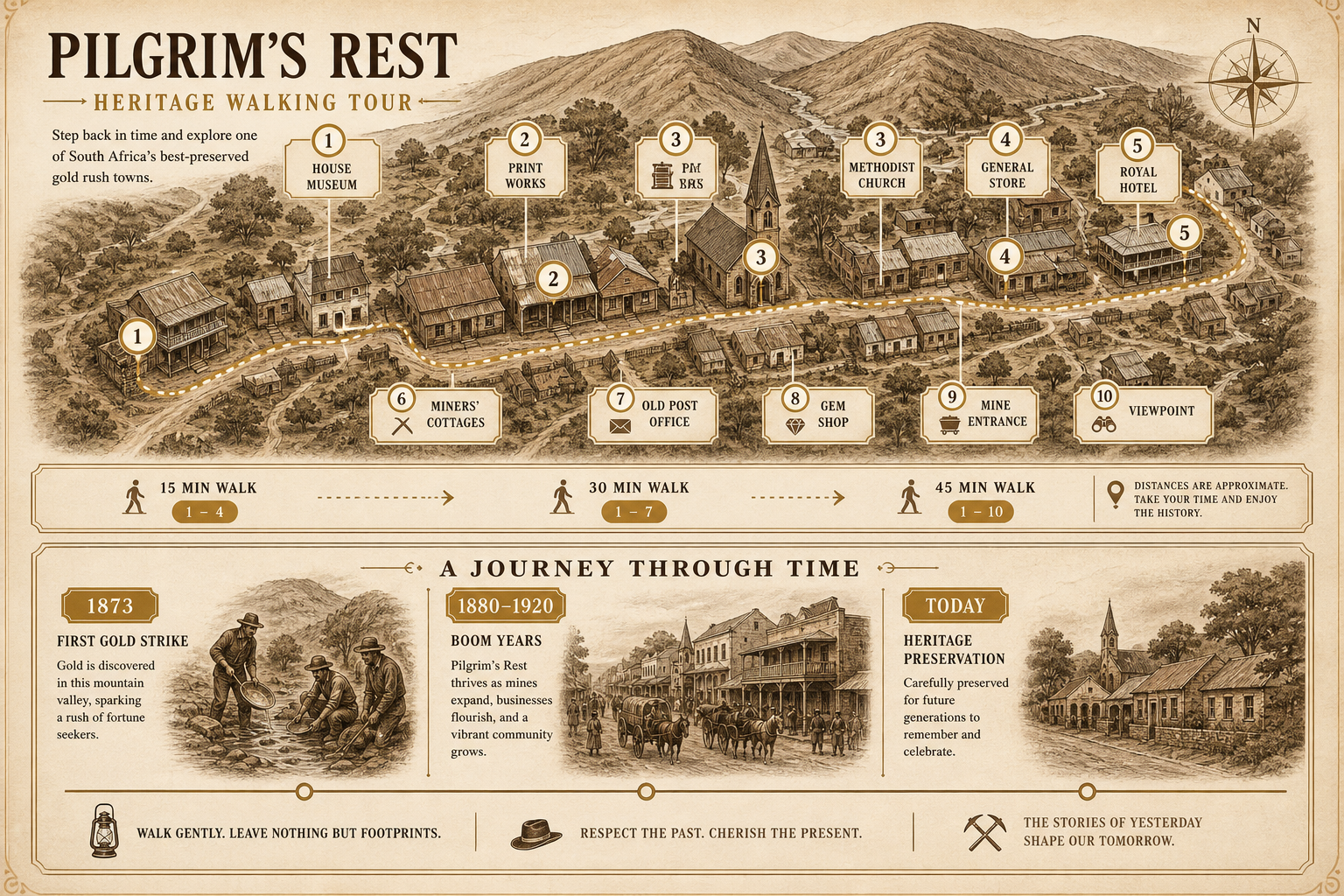
Here’s how a good day unfolds:
Morning: Start with the House Museum and Print Works to get a sense of daily life during the gold-rush era. Both are original structures with period furnishings and artefacts. Spend an hour here; the museum staff are helpful and often local.
Mid-morning: Walk the main street slowly. Stop into shops that are still operating (the general store has a real counter and goods that haven’t changed in decades). Pop into the Church if it’s open. The whole main village can be walked in about 45 minutes if you’re moving, but you’ll want to linger – the photography and the feeling are the point.
Afternoon: Either take a guided heritage walk (booking ahead is wise), or hike one of the nearby trails. The Robber’s Grave route is a popular 5km walk through mountain forest with views back over the town – it takes about 2 hours and is moderately easy. The light through the trees in late afternoon is stunning.
Late afternoon/evening: Eat at one of the village restaurants (they’re good and modest-priced), watch the light change through the buildings, and sit quietly. This is the best time for photography.
If you’re staying overnight, a second day gives you time to hike further afield into the surrounding mountains or sit in a garden with a book and coffee, which is exactly what this place invites you to do.
How Much Does It Cost?
This is where Pilgrim’s Rest becomes a serious contender for budget travellers. Here’s what a typical visit costs:
- Accommodation: Ranges from R200–1,800 per night depending on comfort level. Budget guesthouses and B&Bs run R200–400. Mid-range options (still locally owned) run R400–800. Luxury stays are available but you’re not coming here for that.
- Meals: A dinner at a village restaurant (good quality, local) runs R80–150. Lunch is similar. Breakfasts from R40–80. If you self-cater (there’s a small grocery), you can eat for R60–100 per day.
- Entry fees: R30 for the village, R20–30 per individual museum if you want to go into the extras, R100–150 for a guided tour.
- Transport: Fuel, if you’re driving from Johannesburg, adds R300–500 depending on your vehicle. If you’re basing yourself in nearby Graskop (30 minutes away), you can day-trip it.

A realistic budget for a day visit from Johannesburg: R600–800 including fuel, entry, lunch, and a guided tour. For an overnight stay: R1,000–1,500 including accommodation, meals, and activities.
Compare that to what you’d spend on a Kruger National Park day trip or a Hermanus whale-watching weekend, and Pilgrim’s Rest is a bargain – and arguably more memorable.
Getting There and Practical Details
Pilgrim’s Rest is located 16km from Graskop, which is about 2.5 hours from Nelspruit, 5–6 hours from Johannesburg, and 4 hours from Durban. The road up the mountain is well-maintained and scenic. If you’re coming from Johannesburg, the N4 highway toward Nelspruit is straightforward; from Nelspruit, follow signs toward Graskop and then to Pilgrim’s Rest. If you’re already on the Panorama Route (visiting places like Blyde River Canyon or God’s Window), Pilgrim’s Rest is a natural add-on – it’s 30–45 minutes from most Panorama Route accommodation.
The best time to visit is May through September – South African winter, when the weather is crisp, the light is clear, and the mountain mists add to the atmosphere. December through February is hot and humid, though not impossible.
Bring good walking shoes, a warm layer (even in “summer,” the mountains cool down fast), and a camera if photography matters to you. There’s no cell service in the village (which is part of its charm), so plan accordingly. Restaurants have WiFi if you need it, but the general vibe is unplugged.
The Real Magic: Stories Still Living Here
What transforms Pilgrim’s Rest from a nice heritage site into something genuinely moving is that real people live here. When you eat at a restaurant run by the third generation of a family that’s been in this town for a hundred years, when a guide tells you they grew up in one of the heritage houses, when you realize the shopkeeper is a descendant of early miners – the place stops being a museum and becomes a conversation across time.
“My great-grandfather came here during the gold rush,” one local guide shared. “He didn’t strike it rich in gold, but he built a shop and raised a family. The shop is still here. We’re still here.” That continuity – that decision to stay, to preserve, to live slowly in a place the world moved past – is the thing that draws people back to Pilgrim’s Rest.
The town was declared a provincial heritage site in 1986, a protection that means the buildings are preserved and the pace is deliberately kept slow. You won’t find chain restaurants, shopping malls, or any of the commercial machinery that flattens everywhere else into sameness. You’ll find people who chose to stay, who chose to maintain this place, and who seem genuinely happy to have you sit quietly in the dust and listen.
The Closing Bell: Why You Need to Go Soon
Pilgrim’s Rest isn’t a secret forever – more travellers find it every year, and it’s starting to appear on bucket lists. The good news is that the heritage protection and the small local population mean it can’t be “developed” into something else. It will stay slow, real, and quietly powerful.
But the specific magic of discovering a place that most South Africans haven’t heard of – of walking streets where your footsteps echo, of eating dinner in the fading light with mountains holding you in – that changes as word spreads.
Go in winter, when the light is soft and the town feels most like a memory. Stay for at least one night so you can experience the darkness and the quiet. Sit on a verandah with a coffee and listen. Hike the Robber’s Grave trail and think about all the people who walked these mountains looking for something. And when you leave, you’ll understand why the people who live here chose never to go anywhere else.
Pilgrim’s Rest isn’t trying to be anything other than what it is: a town built on a golden dream, frozen in time, waiting patiently for people ready to slow down and listen.